
June 12, 2026, SF
There’s an old American expression: “Get out of Dodge.”
Yesterday afternoon, I did the opposite…not that I wanted to get into any kind of trouble.
I’d spent the earlier part of the day at the Filipino American Center inside San Francisco’s Main Library, ducking the summer heat and chasing a few boxing ghosts. Old fighters’ stories still pull me in that way.
By the time I stepped back outside, I realized another story was waiting just down the block.
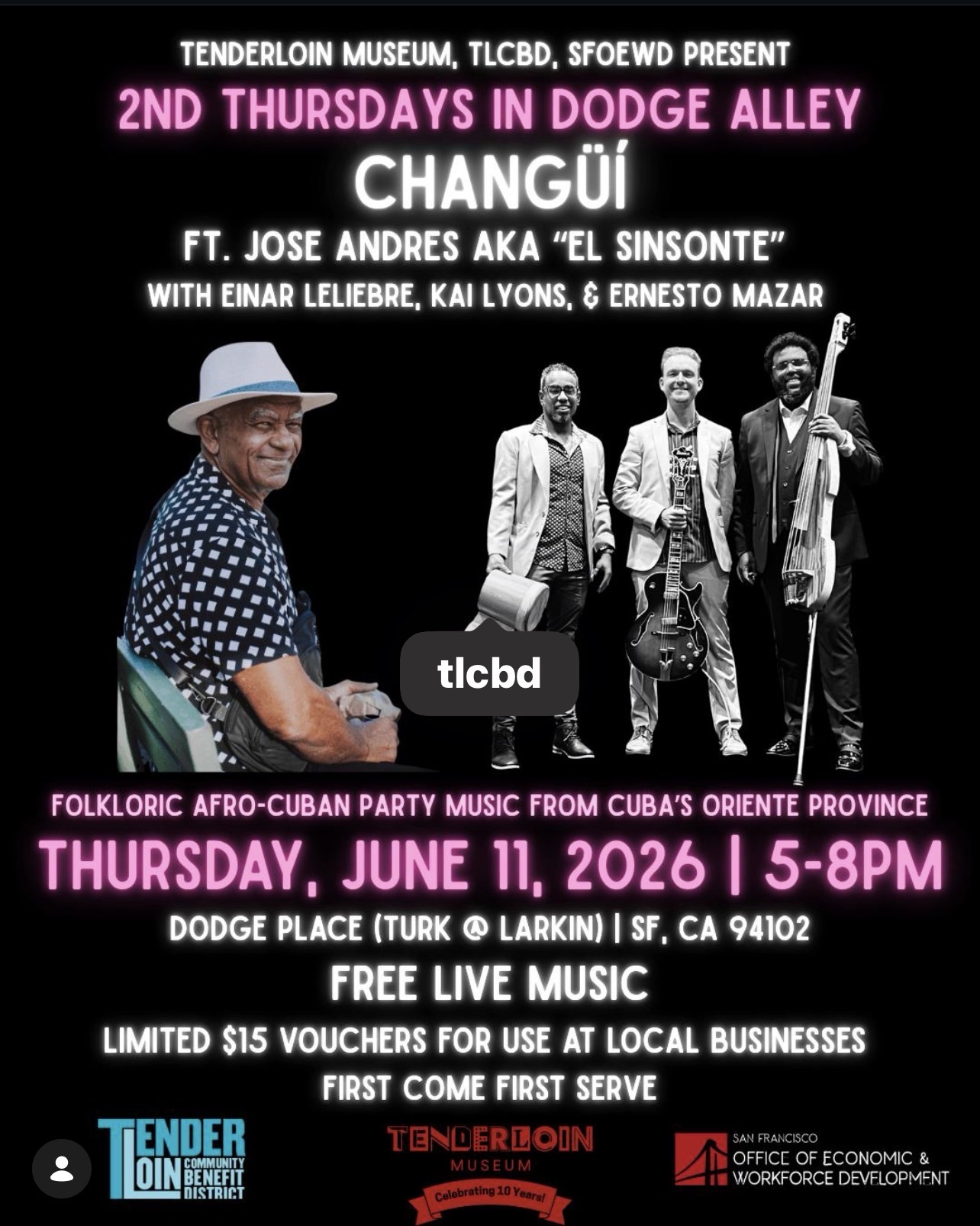
Between Hyde and Larkin on Turk Street, there’s a narrow passage called Dodge Alley.
Easy to miss if you’re not looking for it.
But on the second Thursday of every month, it becomes something else. Music spills out. Neighbors pull up chairs. Visitors and residents start talking like old friends.
For a few hours, it’s a small working model of what community can be when people collaborate to build it.

Alex Spoto told me about the event last week, and I took up his invitation. He’s the Program Director at the Tenderloin Museum, a transplant from Tampa who landed in San Francisco and now works alongside Executive Director Katie Conry.
Together they tell the story of one of the city’s most misread neighborhoods— through engaging exhibits, walking tours, and events like this one, showing a Tenderloin shaped by more than its struggles.
History, culture, resilience, people. Dodge Alley is that mission, live and in color.
That afternoon the music came from Changüí, a Cuban group that turned the alley into an open-air party within minutes.
People smiled, swayed to the Latin beat, and visitors stayed a while.
For a few hours, the hustle and bustle of the city seemed far away.

Then the singers of Changüí Sonico launched into “Guantanamera.”
Cuba’s gifts to the world extend well beyond music. The island nation is known for its culture, tobacco, and a boxing tradition that has produced generations of champions.
One of them, Guillermo Rigondeaux, would eventually cross paths with Filipino star John Riel Casimero years later. This afternoon, however, it was not boxing that carried Cuba into the Tenderloin. It was a song.
It hit me immediately— my late father used to sing that song around the house when I was a kid. For years, I’d had it mistaken as Brazilian.
Brazilians mainly speak Portuguese; “Guantanamera” is Cuban through and through.
I stand corrected.

That afternoon, strangers from different backgrounds gathered, listening to the heartwarming tune from the Caribbean, sharing the same patch of pavement.
Music did what it does best— unite.

Next month’s act is The Sampaguitas—a name that stopped me in my tracks.
The sampaguita is the national flower of the Philippines, known for being beautiful, humble, and tough. I’m curious to hear what a trio with that name sounds like.
A few steps from the alley sits the Cadillac Hotel, home to the Tenderloin Museum and once the site of Newman’s Gym. I couldn’t let that pass without a thought.
The museum is expanding into that old gym space now, holding onto a piece of the neighborhood’s history. For decades, Newman’s Gym took in fighters, trainers, and dreamers of every stripe.
Standing there, just steps from where the ring used to be, I thought about the Filipino fighters who passed through San Francisco in the early twentieth century— Pancho Villa, Elino Flores, Pete Sarmiento, and plenty of others whose names didn’t make it into the record books.
I could picture them feeling at home around here. Not because the alley looked the same back then, but because the vibe hasn’t changed.

The Tenderloin has always been a landing spot. A place where new arrivals found work, friendship, and a foothold. A place where cultures intermingled and, somehow, made the city better for it.
Tony Bennett sang that he left his heart in San Francisco. Most people picture cable cars or the Golden Gate Bridge when they hear that line.
But the city’s heart shows up in smaller places too—an old boxing gym about to start a new chapter, a museum holding onto memory, a Cuban song drifting through a Tenderloin alley.
And on the second Thursday of every month, you’ll find it between Hyde and Larkin on Turk Street.

Its name is Dodge Place Gardens—Dodge Alley.