

Some boxing men become either famous or legendary. A select few become institutions.
Billy Newman belonged to that last and rarest category.
Long before boxing found its modern homes in casinos, convention centers, and television studios, it lived in neighborhood gyms.
The gym was where fighters learned to punch, but more importantly, where they learned discipline, respect, and perseverance. It was where champions were built long before anyone knew their names.
For generations of San Francisco fighters, that place was Newman’s Gym.
Located on Leavenworth Street, Newman’s Gym became one of the city’s most enduring boxing landmarks. Champions trained there. Contenders passed through its doors. So did dreamers, troubled youngsters, old fighters with fading memories, and ordinary people who simply loved the fight game.
At the center of it all stood Billy Newman.
When Newman passed away in March 1984 at the age of eighty-one, boxing lost one of its most beloved caretakers. Yet his legacy was never measured in championship belts, promotional contracts, or financial success. His true accomplishment was creating a place where people felt they belonged.

The heartwarming obituary written by Stephanie Salter of the San Francisco Examiner captured that truth beautifully. Through the recollections of those who knew him best, a portrait emerges of a man who devoted his life to helping others while asking very little in return.
Born in Brooklyn, New York, on February 21, 1903, Newman came from humble beginnings. He lost both of his parents while still a young man, but he carried their memory with him throughout his life. Friends recalled that he kept photographs of his parents nearby and regularly lit votive candles beside a portrait of his mother.
Before becoming one of boxing’s most respected figures, Newman earned his living as a bricklayer and construction foreman. He boxed professionally during the 1920s and 1930s while working hard to support himself. One of the most striking photographs preserved at the gym showed him standing high above New York during the construction of the Empire State Building, a reminder of the courage and determination that defined his generation.
Eventually, a journey west brought him to California.
According to longtime associate Jon Lucero, Newman liked to say he fell in love with a palm tree and bought the house standing in front of it. Whether entirely true or slightly embellished, the story perfectly reflected the warmth and humor remembered by those who knew him.
His partnership with Joe Herman became one of the most important relationships in San Francisco boxing. Together they managed fighters, promoted events, and eventually took over Paddy Ryan’s Gym at 312 Leavenworth Street in 1942. Over time, the facility would become known simply and affectionately as Newman’s Gym.
What Newman is remembered for is not any single fighter. It is the decades he spent keeping the doors open.
Champions and beginners walked through the same entrance and received identical treatment, which is to say nobody received special treatment. You worked, or you found somewhere else not to work.
If a fighter needed gear, Newman found a way. If someone was short on money, he covered it. He never made a thing of it.
The name stuck because Billy Newman was everywhere.
He was not merely the owner.
He was the spirit of the place.
Stories about his generosity became part of local boxing folklore. If a fighter could not afford equipment, Newman found a way to help. If a boxer needed a loan, he often provided one. If a promising prospect lacked the means to continue training, Newman quietly covered expenses and never sought recognition.
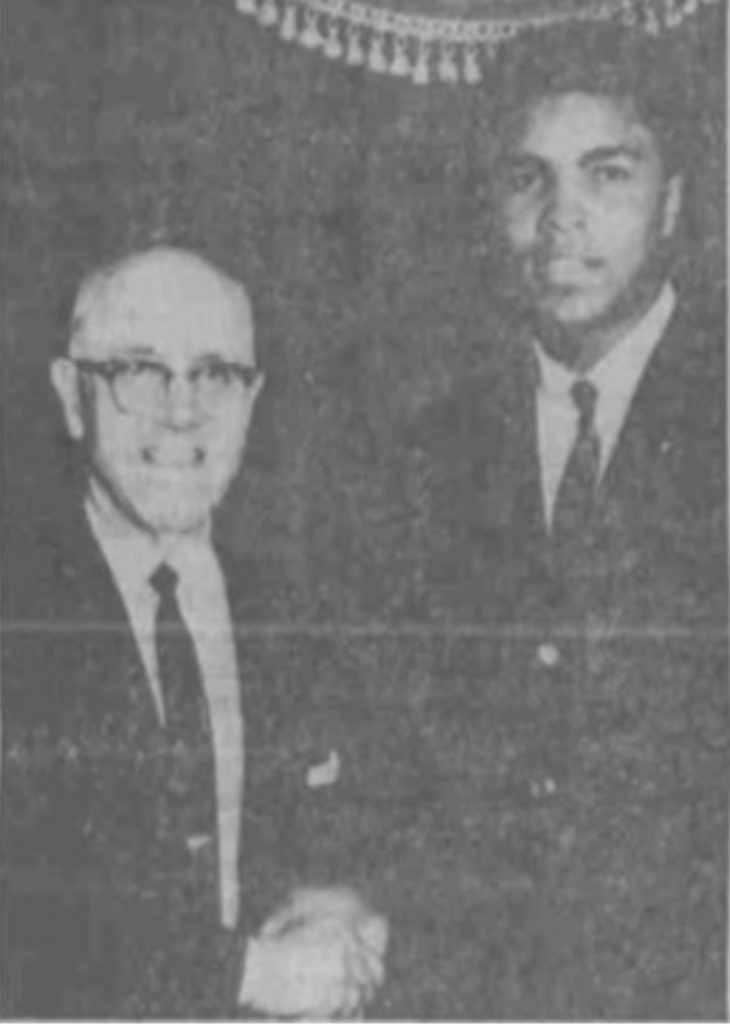
And there was a nineteen-year-old from Louisville, Kentucky, who walked through the door sometime around 1960. Known at the time as Cassius Clay, he had just won the national amateur light heavyweight title in San Francisco and punched his ticket to the Rome Olympics.
He was supposed to go home. He could not — he hated flying, missed his ride, and ended up staying a stretch.
He trained at Newman’s during those weeks, and when it was finally time to leave, Billy Newman reached into his pocket and handed the young man three hundred dollars to get back to Louisville by ground.
The man who became Muhammad Ali never forgot it.
Several of his associates recalled that if Newman believed a fighter no longer had a future in boxing, he would tell him so. He would rather disappoint a young man than allow him to waste years chasing a dream that was no longer realistic. Sometimes he even tore up contracts rather than profit from someone else’s false hope.
That kind of integrity is rare in any era.
His concern extended beyond the fighters themselves. He worried about their families. He found ways to help them remain close while training and traveling. If a fighter had a poor payday, Newman occasionally sacrificed part of his own share to make sure the boxer received what he needed.
He understood that boxing was about people first.
Twenty years before his passing, Newman established a free boxing program for children fifteen years old and younger. The arrangement was simple. The youngsters showed up, and Billy supplied the gloves, instruction, and encouragement.
“It keeps them off the street,” he explained.
Those few words reveal everything one needs to know about the man.
Money never seemed to matter very much to him. By the early 1980s, the gym was reportedly losing money year after year. Friends had to persuade him to raise membership dues from eight dollars to ten dollars. Even then, Newman resisted.
He wanted the doors to remain open.
He wanted former fighters to have somewhere to gather.
He wanted young kids to have somewhere to learn.
He wanted boxing to survive.
Outside the gym, Newman quietly supported charitable causes throughout San Francisco. He donated to churches, neighborhood organizations, and community fundraisers. He contributed to St. Boniface Church, St. Anthony’s Dining Room, and St. Mary’s Cathedral. Yet he never sought headlines for his generosity.
As one friend observed, Billy Newman never wanted publicity.
He simply wanted to help.
Life tested him repeatedly. During World War II, Newman was diagnosed with cancer of the colon and small intestine. Doctors reportedly told him he would not survive. Yet he refused to surrender. Year after year, he outlived their predictions, demonstrating the same fighting spirit he admired in the boxers who trained under his watch.
In many ways, Billy Newman embodied the best qualities of boxing itself: resilience, courage, honesty, and compassion.
Today, decades after his passing, his name remains inseparable from the gym he loved.
That may be the greatest tribute of all.
Buildings change. Neighborhoods change. Champions come and go. Yet among boxing people, the old gym on Leavenworth is still remembered by the same name.
Newman’s Gym.
Not because Billy Newman sought immortality.
Not because he demanded recognition.
But because he spent a lifetime opening the doors for others.
The champions came to train.
The old-timers came to remember.
The kids came to learn.
And all of them came home…champions all.
Acknowledgment and Fair Use Attribution
- This article contains selected excerpts, quotations, images, and archival references used under the Fair Use provisions of Section 107 of the United States Copyright Act. These materials are presented for educational, scholarly, and cultural preservation purposes. Every effort has been made to properly attribute sources and limit use to what is necessary to honor the historical and cultural narrative.
- The Philippine Boxing Historical Society & Hall of Fame gratefully acknowledges journalist Stephanie Salter and the San Francisco Examiner for her moving March 4, 1984 obituary feature on Billy Newman.
- The historical details and recollections referenced in this tribute were inspired by and drawn from her reporting, which preserved the memories of Newman’s friends, associates, and the San Francisco boxing community.
- Special thanks to Christina Moretta and the San Francisco History Center for their generosity in providing Billy Newman’s photograph
- The accompanying newspaper article is reproduced for purposes of historical preservation, scholarship, commentary, and education under principles of fair use. Ms. Salter’s work remains an invaluable record of one of the most respected figures in San Francisco boxing history.